The Access Illusion: Why Giving Everyone ChatGPT Won't Fix AI Inequality
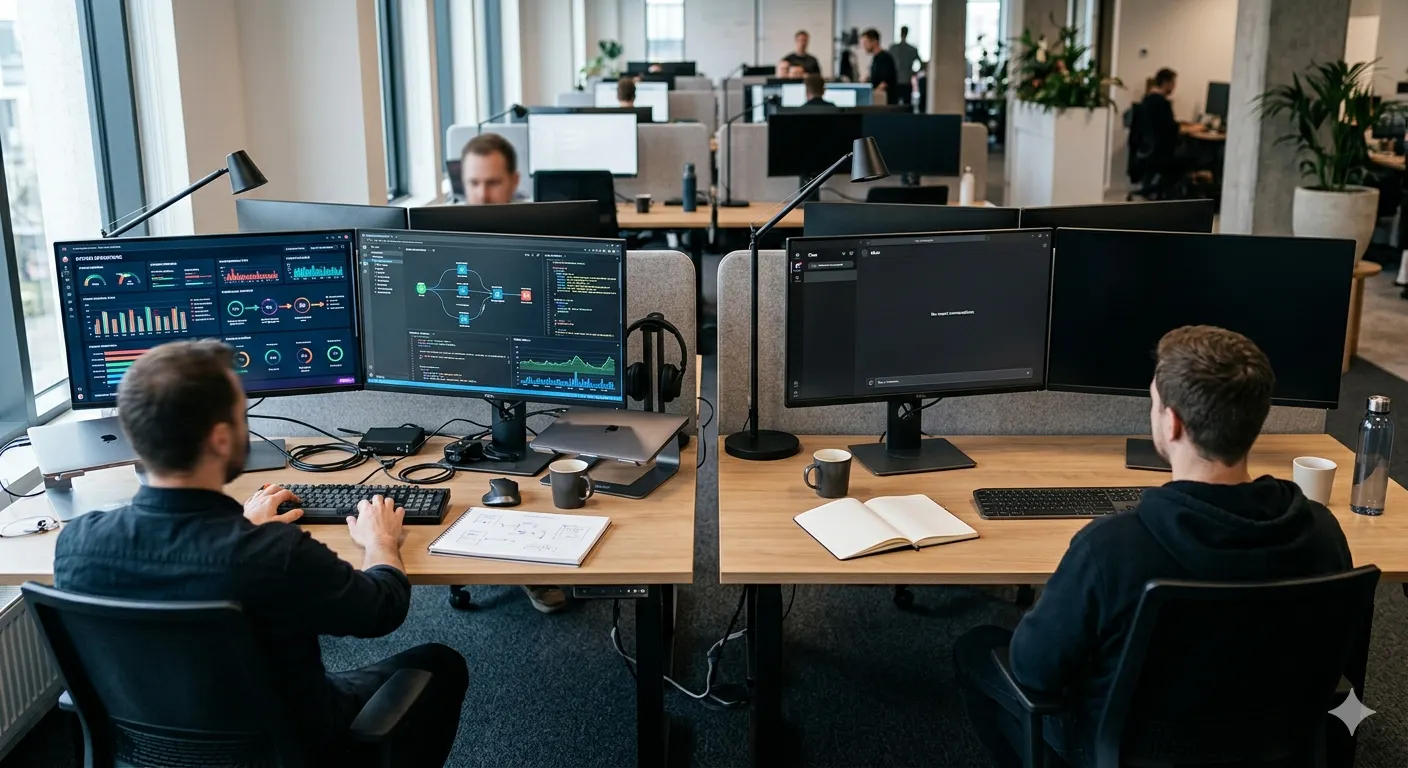
Imagine two people in the same office with the same AI tools. One week later, Person A has restructured how they work: prototyping in hours, automating workflows, writing tests with AI. Person B uses it to rewrite emails. Person C hasn’t opened it.
The gap between them has little to do with access and everything to do with a kind of AI literacy that no corporate rollout can fix. We all know these archetypes, and I believe what we’re seeing is a preview of what’s about to play out across society.
What I See at Work
In GovTech, everyone has access to the same AI tools, including Claude Code, which many assume is only for engineers. Apart from building things, I’ve seen many others already use it to draft spec reviews, analyse data, creating customised dashboards, automate reporting. It’s functionally agnostic, but adoption isn’t turning out to be.
Pockets of engineering and data science teams are pulling ahead in ways that are hard to overstate. Meanwhile, in domains like product, policy, comms, HR, corporate functions, the tools are not as effectively wielded.
As a result, you end up with a two-speed workplace, where one group is compounding its productivity week over week, while the other continues working the same way it did before.
To me, this workplace phenomenon is a microcosm of the wider society & economy, and I think we’re responding to it in the wrong way.
The Access Illusion
Singapore’s national AI task force recently announced that Singaporeans who enrol in selected SkillsFuture AI courses will receive six months of free premium AI subscriptions. Minister Tan See Leng framed it pretty well: “Like learning a language, developing true fluency in AI comes from consistent use and building confidence through experimentation.” I broadly agree with the mission, but the prescription undermines it.
A six-month subscription bundled with a course simply does not produce AI fluency. Fluency comes from integrating AI into daily work over months and years, not from a time-boxed trial that expires before the habit forms. In addition, the subscriptions are conditional on course enrollment; thus, the people least likely to sign up are least likely to get access. This is the same structural problem I wrote about with SkillsFuture credits, where 70% of credits go unused under a poorly designed nationwide upskilling program.
People who aren’t using AI effectively don’t lack a login to ChatGPT. Instead, what they lack is a frame of reference: the ability to look at their work and see where AI fits, not as a shortcut for individual tasks, but as a restructuring of how the work gets done. It’s no wonder that McKinsey finds that 3/5 SEA firms haven’t achieved meaningful gains from AI despite having access. The bottleneck is becoming less about access.
Inequality compounds, and history confirms that. What’s new to this form of AI inequality is its speed. The person who started using coding agents in 2024 was building agentic workflows by 2025 and automating their work & life in 2026. The person who never got comfortable with the basics, overwhelmed by the volume and velocity of change, is never going to leap to autonomous agents, falling further behind with every cycle.
Don’t get me wrong, access matters too, because power sits behind subscriptions, credits and tokens, and that’s a real decision if you’re making the median income and unsure if the tool is useful to you. But there’s no plan for what happens when the six months expire. And learning AI well requires hours of unstructured experimentation that most people’s bosses won’t give them.
The Original Failure of Education
In the long run, the fix is in education. This isn’t just about teaching AI to students, but rethinking what education looks like in an AI world, and what continued education means for millions of working adults who graduated before any of this existed.
Singapore’s pre-U education system shaped today’s workforce for a world that is increasingly outdated. We were never taught to stare at an ambiguous problem and figure out which parts an AI could handle. Actually, we had twenty years to embed systems thinking and comfort with ambiguity into how we teach. But we didn’t, because we lacked the imagination to see how advanced these tools would become. Now we’re playing catch-up, as the education system often does, and the gap widens at an increasingly alarming rate.
The gap isn’t just in knowledge but in thinking (and even metathinking) that takes many formative years to develop and that a weekend course cannot ingrain. A SkillsFuture workshop on prompt engineering does not bridge the difference between someone who has spent a decade thinking systemically and someone who has not. And people know this intuitively: when faced with a catalogue of AI courses they can’t evaluate, they default to what’s comfortable.
There’s also the problem of work itself. For example, JDs for Product Managers list stakeholder management and roadmap planning but say nothing about using AI to synthesise customer feedback at scale. People are expected to attach AI onto roles designed without it, and we wonder why adoption is shallow. Most managers have no idea how to redesign the roles of their employees, let alone their own.
The irony is that the people who figure AI out on their own are the ones who least need the help. Everyone else gets a workshop and a badge.
What Needs to Change
1) Rebuild education from the ground up.
China has proposed mandatory AI education from age six, South Korea has invested $960 million in AI-powered textbooks, and Singapore has launched “AI for Fun” modules with deeper integration through MOE. But treating AI as a standalone subject misses the point. AI needs to be embedded as a mode of thinking across every discipline, teaching kids what AI can do reliably, what requires a human, and how to structure problem decomposition and solving around it.
2) Redesign work around AI.
Every job description in Singapore was written for a world without AI. The roles haven’t evolved, and as long as they don’t, adoption stays shallow. To me, the most promising lever is at the sector level, building communities of practice where even non-technical professionals share what’s actually working. In my opinion, Engineering adopts AI fast partly because engineers have meetups and open-source communities where knowledge propagates laterally. HR, finance, and policy professionals don’t have anything equivalent at that level.
On a related note, OpenAI’s “Industrial Policy for the Intelligence Age“ paper proposes giving workers a formal voice in AI deployment: the people doing the work are best positioned to identify which tasks AI should take over. When roles are redesigned with worker input, adoption deepens because people are shaping the change, not absorbing it. And when AI reduces costs, those gains should flow back as efficiency dividends: expanded healthcare, subsidised childcare, even 32-hour workweek pilots.
3) Fund experimentation, not courses.
Instead of routing AI access through SkillsFuture’s broken marketplace, design sector-specific AI integration programmes built by domain practitioners. Give people open experimentation budgets tied to actual work through their employers. Reward those who develop AI workflows that benefit their function, and treat AI fluency like a public good: access to capable AI as foundational infrastructure, the way we treat electricity and internet.
4) Make AI fluency meaningfully measurable.
Singapore has made some efforts: the AI Skills Compass scores individuals’ AI skills, AI Singapore’s Readiness Index measures enterprise readiness, and IMDA tracks broad adoption: 73.8% of workers now use AI tools. But are these measurements really meaningful? Telling a procurement officer she’s “AI Aware” doesn’t help her understand what AI literacy means in the procurement domain. We need sector-specific benchmarks tied to real workflows.
The Window Is Closing
Where will we be in two, five, ten years? At this rate, I won’t pretend to know. But there is nothing in many people’s education, job description, or professional environment that equips them to do what the engineer two desks over does instinctively. That’s a systemic failure, not an individual one, and that requires bold government imagination and intervention.
Multiply it across a society and you get a sharp split in the labour economy. In Singapore, we don’t leave important things to the market, look at our housing, education, healthcare. I think that AI literacy belongs on that list, not as a SkillsFuture add-on or free trial.