SkillsFuture: $500 but nothing much to show for it
“Free money from ah gong just use.”
Don’t get me wrong, the generous Singapore government scheme has noble intentions. Up-skill yourself, future-proof your career, is what the government tells you. In a world that’s changing so quickly (see AI), giving every citizen a budget for training sounds like a rather forward-looking, progressive thing to do.
So in mid-December 2025 you (I) frantically scroll through to the MySkillsFuture portal… data analytics, digital marketing, cybersecurity, cloud computing… but you also see, wine certifications, photography, floral arrangement. If you ever wondered if these were really a good curation of courses, you’re not alone.
The prices of the courses vary quite a bit, and descriptions are often vaguely promising in a way where everything sounds important but nothing sounds very specific. Reviews are sparse, if they exist at all. It’s like when going to a new bar, staring at the cocktail menu with funky names, without a clue what the ingredients mean, and telling yourself you’ll just choose whatever the bartender recommends.
And it’s not because you’re lazy, in fact, most Singaporeans never touch the money. Those who do often spent it on career-irrelevant courses, while the rest got roped in by providers who operate, as one Redditor put it, “like MLM/insurance agencies.”
The policy intent behind SkillsFuture was good. The Singapore government looked at a rapidly changing skills economy, saw that workers needed to continuously re-skill in order to remain productive and relevant, and decided to put money directly into citizens’ hands to do so. It’s a pretty laissez-faire approach to human capital.
But as with most plans that rely on people deciding what’s best, the assumption that people have enough information to know what’s best for themselves falls flat pretty quickly.
Thus, the outcomes we witness today of the SkillsFuture program are, in hindsight, entirely predictable.
The basic economics of incentives, information, and uncertainty predict all three failure modes of the SkillsFuture program, and I put forth (rather long) qualitative and quantitative arguments below to convince you that it’s a serious problem that goes beyond mere anecdotes.
Most of the intuitions below may already be held by many, but a simple microeconomic framework helps to bring everything together and provide some rational coherence to what we’re feeling. It shows why the money sits unused, why it flows to baking classes, and why aggressive marketers feast on the scheme.
To be clear, this isn’t to say that every individual consciously runs through utility functions and partial derivatives before choosing a course — if you do, nothing wrong with hyper-optimising your life that way but you might be quite a special snowflake. But the framework gives us a useful lens for understanding why these patterns emerge at scale, and more importantly, what we can do about it.
If you want to get through this article more quickly, feel free to skip all the equations in italics : )
And to be extra clear, I have nothing directly against baking classes or wine certifications. If it helps you pivot towards a personal business or advance in your profession, by all means, please continue supporting these courses
For readers less familiar with Singapore: SkillsFuture Credit is a national initiative where the Singapore government gives every adult citizen $500 that can be used to offset fees for courses listed on the official MySkillsFuture portal. The courses are offered by a wide variety of private and public providers, all of which must be “endorsed” by SkillsFuture Singapore (SSG) to be listed. However, the endorsement criteria are relatively lax, and the menu spans everything from data science bootcamps to flower arrangement workshops. There is no strong vetting of whether courses actually deliver professional value. It’s a barely curated education buffet.
The Benchmark of what should happen
Let’s first establish what right looks like.
In the ideal version of this policy, each person receives their $500, surveys the available courses, and does a sensible cost-benefit analysis. tailored to their own skills, prospects, utilities, estimating which course would most improve their career prospects. They weigh that against the price, net of the subsidy, and the time they’d have to invest, and pick the option with the best return over cost. The government subsidises, the individual optimises, and the social planner achieves his or her objective of a more skilled, productive workforce.
Let’s put some modelling structure on this so we have a vocabulary for what follows (the Economics framework and its equations often lends clarity whenever I get into discussions with others around these topics). Each course i has a true productivity return (call it q_i) which captures how much the course would genuinely improve someone’s career prospects. It has a price p_i. After the $500 subsidy S, the learner pays out of pocket:
c_i = max(p_i − S, 0)
But cost isn’t just money, there’s also the time and mental effort required to find the right course in the first place, scrolling through course descriptions, comparing options, maybe asking around to get recommendations - in Economics we call the search cost k, and it’s actually not that trivial. Anyone who’s spent an evening on the MySkillsFuture website trying to figure out which “Data & AI” course among near-identical listings is actually worth attending knows this is real friction (which at times does not yield anything).
Now, from society’s perspective, from the viewpoint of a social planner, the decision rule would be simple:
Take course i if: q_i ≥ c_i + k
If the productivity gain exceeds what it costs (in money and effort), then the social planner would want you to take the course. And that’s the world that the policy was probably designed for, one where rational individuals, armed with perfect information, channel subsidised training toward courses that maximise the growth of their professional capability.
But people need to actually know how much a course will help their career before they sign up. They need to see q_i, and that’s kinda where this all breaks down.
The Information Problem
If you go to the MySkillsFuture portal right now and try to figure out which course will actually help your career, you’ll see many titles, they all sound great, and a few even have testimonials.
But what can you actually tell from a course listing? You can see what topics are covered, you might get a sense of the instructor’s credentials. But what you cannot see, and what you have essentially no way of judging before you sign up, attend, complete, and then spend a year trying to apply what you learned, is the thing that actually matters: will this course up-skill me in a way that advances my career growth?
This is what economists often call a credence good. A waffle from Swee Heng: you know immediately if it’s good. A subscription to Claude Code: you figure out after a few nights of vibe coding. A training course? You often can’t evaluate its quality even after you’ve finished it, that’s a credence good.
Did that data science certificate help you pivot your career, get a promotion? Or would you have gotten it anyway? The professional returns may take years to materialise (or they might never), and by then you can’t separate the effect of the course from everything else that happened in your career. That’s a tough effect to measure, and to be clear it’s not unique to just SkillsFuture.
The course provider, on the other hand, has a much better sense of what they’re selling. They know if their instructor is a seasoned practitioner or someone who’s knowledge of Data Science lives in the early 2000s. They know if the curriculum is rigorous, and they probably have some sense of whether their graduates are getting hired. This gap, where the seller knows far more about the product than the buyer, is the textbook definition of information asymmetry. All you Econs students should be familiar with this.
One SkillsFuture course trainer put it rather honestly on Reddit: “What we teach you in school are the basics. The course is comparable to me being a driving instructor — you learn the accelerator, brake, gears, and get started moving. But in the real world, most are NASCAR racers, the top are F1 drivers.” In other words: the course gets you started, but the gap between what you learn and what the job actually demands is enormous, and there’s no way to know how big that gap is before you sign up.
So what shapes your perception of a course’s value? Three things, and none of them are the actual quality of the course:
- Partial observability You can see some signals of quality. A syllabus, an instructor resume, maybe some reviews, but these signals are noisy and incomplete. An extremely detailed syllabus might mean a well-designed course, or it might mean someone overpromising you after having spent 10 minutes with ChatGPT making a detailed syllabus. You really cannot tell.
- Marketing distortion Providers can invest in making their course look better than it is, through overly inflated testimonials, nice websites, in-person sales. These shift your perception of quality without changing the underlying quality of product, and some providers invest extremely heavily here, you see them hanging around in your neighbourhood mall or market, like their close cousins the real estate agents.
- Irreducible uncertainty Even with perfect research, you genuinely cannot know how valuable a course will be for your specific career. Maybe AI will make the skill obsolete by the time you finish, maybe your company will restructure and force your into a role you’re not prepared for, maybe you’ll discover you hate the field in 2 years time, who can tell? Some uncertainty just… exists.
Let’s put this into a simple framework. If the true quality of a course is q_i, then what you perceive when browsing for a course is:
q̃_i = θq_i + m_i + ε_i
The θ term (between 0 and 1) captures how much of the real quality actually gets to you, so think of it as the transparency factor. If θ = 1, you can see everything related to quality; if θ = 0.2, you’re probably guessing. The m_i term is the marketing inflation, which is the gap between how good the course looks and how good it is. And ε_i is pure noise, random variation with variance σ^2, representing the stuff nobody can predict. Usual microeconomic modelling.
You can probably see where this is going - most people don’t just care about the expected outcome, but they also care about how uncertain that outcome is.
For the uninitiated, think of it this way, if someone offers you two options: a guaranteed $100, or a coin flip where you get $200 on heads and $0 on tails, the expected value is the same $100 either way. But most people take the guarantee. Not because they’re bad at math, but because the downside of getting nothing feels worse than the upside of getting an extra $100 feels good. There’s a formal term for it and it’s called risk aversion, and it’s one of the more interesting things you first learn when you enter a microeconomics behaviour economics course.
For SkillsFuture courses, the uncertainty can be pretty massive. Instead of flipping a coin, you’re making a bet on a course whose returns depend on your aptitude, your employer’s needs, the instructor’s skill, the job market, and a dozen other factors you simply cannot control. A risk-averse person, which I believe characterises most Singaporeans, behaves as if they mentally penalise expected benefit. So the more uncertain the outcome, the bigger the penalty.
Formally, the penalty works out to be (see appendix for formal proof):
½γσ²
where γ captures how risk-averse you are and σ^2 captures how uncertain things feel.
The individual’s decision rule becomes:
Enroll if: θq_i + m_i + E_i ≥ c_i + k + ½γσ²
Compare this to what the social planner wants, where you take a course whenever the true return exceeds the cost:
q_i ≥ c_i + k.
The individual’s rule has all the extra calculus baggage. Quality is discounted by θ because you can’t fully see it. Marketing m_i inflates what you think you’re getting. Enjoyment E_i enters the calculation even though it doesn’t boost productivity, and the risk penalty drags everything down because the professional returns feel like a massive uncertainty.
We can be specific about the exact gap, sort of a wedge between what individuals choose and what society needs, by subtracting the planner’s rule from the individual’s:
Δ_i = (θ − 1)q_i + m_i + E_i − ½γσ²
This single expression encapsulate what I believe is wrong with SkillsFuture credits. Each term is a different way the individual’s decision diverges from what’s socially optimal. The (θ - 1)q_i term is always negative, since people systematically undervalue genuinely good courses because they can’t observe actual quality. The m_i term inflates demand for heavily marketed courses regardless of actual quality. The E_i term pulls spending towards consumption and instantaneous gratification. And the risk penalty discourages enrolment entirely.
These can be understood as three failure modes, finally let’s get into it.
Failure Mode 1 — The Money Just Sits There
Seven in ten Singaporeans had not used their one-off $500 SkillsFuture Credit top-up as of late 2025, despite the expiry deadline. That’s a clear symptom of allocative failure if you ask me.
The government put $500 into people’s accounts for professional development, and the overwhelming majority just didn’t use it, how bewildering!
The easy explanation is laziness or apathy. The more honest explanation is that people looked at the options, couldn’t figure out what was worth doing, and made a perfectly rational decision to do nothing.
CNA’s reporting was pretty revealing, many folks were “put off by confusing SkillsFuture course listings and a lack of courses that fit the time and financial commitments they were willing to make.” That’s not laziness but a coherent complaint about the information environment surrounding courses.
The individual stories are even more compelling. One individual described searching for courses in law, nursing, communications, teaching, and finance, but coming up mostly empty. She called SkillsFuture’s catalogue lacking in “value for money, curated and current” options. There’s a strong desire to up-skill, but the platform didn’t offer anything good enough to justify the commitment.
Another individual raised a different but related problem: there wasn’t enough “reliable information, such as ratings and student feedback” for her to commit to a course. She was confused by courses listed at different prices with no clear explanation of what really justified the difference. You see three Data Science courses priced at $800, $1,200, and $2,000, and you have no way of telling if the expensive one is three times better, slightly better, or actually worse. It’s no wonder that people drop off the search for courses. A career coach identified the core issue, that people are held back by “a lack of clarity about what to study and the return on investment on learning.”
And the time cost is quite real for working adults, as one individual told CNA: “Some courses were three days a week after work, and barely swallowing down one’s dinner, with homework and tests, for a one-year period. I was quite burnt out.” You’re asking a working adult to sacrifice their (limited) free time on something that might help their career, based on a course listing that tells them almost nothing about whether it actually will. Sure, the $500 covers the fee, but nobody’s subsidising the amount of time, energy investment that’s required from folks already working hard everyday.
It sounds slightly extreme but when you can’t tell what’s good, the expected value of any course collapses toward zero. And it’s not because every course is bad, I am inclined to believe some are genuinely useful, but the signal is drowned in noise. Meanwhile, the costs are concrete with co-payment, time, effort, essentially you know exactly what you’re giving up without having an idea of what you’re getting in return.
So people stay home.
The formal model looks something like this - even when a course has genuine positive returns, when q_i > c_i + k, meaning the true productivity gain exceeds the real cost, individuals will still rationally opt out whenever:
θq_i < c_i + k + ½γσ²
The left side is what you can see of the quality, already discounted because θ < 1. The right side is the full cost plus the risk penalty you mentally impose because the outcome feels like an uncertain risk. For courses with moderate returns, in a market with poor information (low θ) and high uncertainty (high σ^2), this inequality holds easily.
What this means is that there’s a whole range of courses sitting in sort of a dead zone, courses that could be socially valuable, that would make people more productive, that a well-informed planner would want people to take, but that nobody touches because the information environment makes them look like bad options.
The worse the information (lower θ, higher σ^2), the wider this dead zone becomes. Just onboarding more providers and providing a wider menu does not mean more utility from choice, but instead increase the amount of uncertainty. Eventually, we end up with credits that expire unused.
The $500 subsidy doesn’t address this problem, it reduces c_i (the out-of-pocket cost), but it doesn’t affect θ (quality is still invisible), it doesn’t reduce σ^2 (outcomes are still uncertain), and it doesn’t lower γ (people are still risk-averse). We’ve made the courses cheaper but not easier to evaluate, and that’s not something you can do just by dropping money from the sky.
Failure Mode 2 — The Wrong Courses
We all know someone who spent their SkillsFuture credits on a wine course (like WSET), or fixing air conditioners, or baking, or photography. It makes for a fun dinner conversation, but it does raise an obvious question: is that really what the policy was designed for?
Among those who actually use their credits, a notable share spend them on courses that provide genuine personal enjoyment but do absolutely nothing for professional productivity. This pattern was conspicuous enough that even opposition MP Jamus Lim raised it in Parliament (not that I am pro-WP but he did raise a good point), questioning whether courses “associated more with consumption — home decoration or flower arrangement or wine tasting” actually serve the scheme’s stated purpose of “genuine, economically-valuable skills acquisition.”
One Redditor admitted:
“I went for a baking course using the money, and discovered I actually had a talent for making Rotis... Go home jiak them also song song gao jurong.”
Wonderful, punny, but not exactly workforce development.
And this behaviour makes complete sense once you understand what individuals are actually facing.
Professional courses have deeply uncertain returns. Will the skills actually be relevant to my job? Will I retain them three months from now? Will my employer even notice, or will I just end up with a digital certificate? You don’t know, and you can’t know, so the returns are probabilistic at best.
In contrast, a wine appreciation class has certain, immediate, tangible value. You walk in, you have fun tasting wines, you have a pleasant evening with your friends, you can show off to your friends that you can taste Damp Leaves notes in your Pinot Noir the next time you visit a wine bar. Benefits abound!
When professional returns are uncertain and personal enjoyment is certain, risk-averse individuals rationally tilt toward consumption. And you can’t say it’s a result of frivolity, instead it’s the predictable consequence of asking people to invest under uncertainty.
The model captures this cleanly. Compare a productive course P, with high true return q_P, but high uncertainty σ_P^2, with a consumption course C, high enjoyment E_C, near-zero uncertainty. The individual chooses the wine class whenever:
E_C > θq_P − ½γσ_P²
The social planner, who only cares about productivity, would always prefer P. But the individual, rationally weighing certain enjoyment against uncertain professional gain, picks C. As risk aversion γ increases, or as the professional course gets harder to evaluate (lower θ, higher σ_P^2), the threshold for choosing consumption drops. Eventually, even a modest baking class beats a potentially transformative data science bootcamp in the individual’s calculus. The investment-oriented subsidy gets channeled in to short-term consumption.
It’s worth being precise about what kind of market failure this is. This is not really adverse selection in the traditional sense, but it’s closer to moral hazard with hidden action. The government provides a subsidy for one purpose (professional development), but the recipient diverts it to another purpose (personal consumption) because the principal (the government) cannot perfectly monitor or enforce the intended use. The information asymmetry here is between the government and the citizen about how the subsidy is actually being spent. Simply put, Ah Gong hands you $500 and says “invest in your career” and so, you say okay thank you and sign up for the wine course.
And honestly, can you blame anyone? If you’re staring at a portal full of courses you can’t evaluate, and the credits are expiring, and there’s a baking class that looks like a fun Saturday, the rational decision is obvious. I almost signed up for the wine course myself, but eventually procrastinated too hard anyway.
Failure Mode 3 — The Upsell
Someone on the same Reddit thread said: “I bought into a SkillsFuture course, thinking that it will help my career prospects but it turned out otherwise. What they are teaching are basic superficial stuff that are pretty useless. The original course fee was $1,400 and $1,000 was paid by my SkillsFuture credits. So I still had to fork out $400 in cash.” The course? Data Science and AI (my own field). Why? Because, as the poster noted, “they know everyone and their mother wants to jump on the AI bandwagon.”
This isn’t an isolated case - another Redditor said: “Personally attended SkillsFuture course, like OP, really just bad experience, and money grab.” Someone else described how a WSQ-affiliated academy tried to push three separate courses on them at a job fair, each $400 to $800, with a vague promise of “job assistance” afterwards.
“Why do you think there are so many of these pestering salesmen on your path? They are opportunists in converting SkillsFuture credit to their pocket cash. Most are just teaching Google knowledge or basics to elderly.”
For those of you who know me, this is something that gets me pretty agitated, and I really wish I were in a position to shut this down.
You see course providers operate booths in shopping malls, pushing courses like real estate agents trying to sell you the next condo launch with the promise of great returns. Someone even said: “Always wondered why they seem to operate so much like MLM/insurance agencies — I guess they do have the same scammy nature.” Another put it even more bluntly: “The only people happy with this are the course providers, most are low quality providers.”
The consensus among these users who actually signed up for courses was telling, and rather consistent. “Only those conducted by the polys are still considered worthwhile. The rest, no.” In essence, the private ecosystem, flooded with subsidised demand, had become a magnet for operators optimising for enrolment volume rather than learning outcomes.
Honestly, are policymakers even surprised?
This is what happens when you flood a market with subsidised demand but don’t meaningfully verify supply quality. Providers spin up companies to capture the rent of profits that the government is supplying, and since consumers can’t tell good courses from bad ones before enrolling (and often not even after - remember, these are credence goods), the providers who win aren’t the ones with the best quality content, but those with the best sales teams.
In the model, firms inflate perceived value through marketing m_i, causing individuals to enrol in courses where:
θq_i + m_i ≥ c_i + k even though q_i < c_i + k
The left side is what the individual perceives (the discounted true quality plus the marketing inflation), the right side is the cost threshold. The individual signs up because the perceived value clears the bar, but the second condition tells you the social reality that the true return q_i doesn’t justify the cost. The course has negative social value. But people sign up anyway because their beliefs have been inflated by m_i with the sales pitch, inflated testimonials, the promise of a career in AI and the fear of getting left behind.
But from the individual’s perspective, when someone else is paying most of the bill, you don’t scrutinise the product, and when you can’t evaluate what you’re buying in the first place, even that reduced scrutiny doesn’t help much.
“Upskilling? (More like) the vendors on SkillsFuture are upselling their courses.” Sad but true.
Why the supply side makes it worse
Now let’s put yourself in the shoes of a training provider. And I know this pretty well because I’ve spent quite a bit of time imagining what I’d do if I were to start my own business in professional education.
You have two levers: invest in quality - better instructors, rigorous assessments, industry partnerships, or invest in marketing, nicer landing pages, LinkedIn testimonials, that one stock photo of a diverse group of (white?) professionals nodding thoughtfully at a whiteboard. You know what I’m talking about.
Quality improvements are expensive (competing with industry salaries for good instructors) and largely invisible (learners can’t tell the difference before enrolling). Marketing is cheap, scalable, and boosts (gullible) enrolment numbers.
MP Jamus Lim (again not pro-WP here just citing a relevant speech) raised this directly, questioning whether SSG adequately evaluates “whether programs proposed by training providers meet not just their stated objectives but contribute toward genuine, economically-valuable skills acquisition.” He also referred to new provisions to police “false or misleading advertising”, which is implicit acknowledgement that the persuasion problem is real and systemic.
The formal logic is as follows - Firm i maximises profit by choosing quality q_i and marketing m_i:
Π_i = p_i · D(θq_i + m_i + E_i) − C(q_i, m_i)
The key asymmetry is that a dollar spent on quality shifts demand by θ times its true effect, discounted because quality is only partially observed. On the other hand, a dollar spent on marketing shifts demand at par, so marketing dominates whenever:
C′_m < C′_q / θ
Since θ < 1, the right-hand side is inflated, quality needs to be much cheaper before a profit-maximising firm bothers with it. The market rewards persuasion over substance because the opacity of the market makes it profit-maximising.
And… the subsidy actually makes this worse. SkillsFuture credits increase demand D(.) without increasing θ, so there’s more money chasing the same opaque market, meaning higher returns to marketing, which means even more marketing relative to quality investment. The government is literally paying firms to get better at selling, not better at teaching. Please let’s not increase the SkillsFuture credits even further.
The Overall Problem
The three failure modes are manifestations of the same underlying pathology: a flat subsidy dropped into a market where consumers can’t tell what’s worth buying.
- Paralysis - you can’t tell what’s good, so you buy nothing
- Substitution - you anchor on certain enjoyment over uncertain investment
- Capture - the loudest seller wins because you can’t tell them apart from the best teacher
The flat subsidy S only affects c_i, reducing the out-of-pocket cost of training. And that’s all there it. It doesn’t touch a single one of the terms identified in the wedge - it doesn’t make quality more observable (θ), it doesn’t reduce uncertainty (σ^2), it doesn’t counteract marketing (m_i — arguably it increases returns to persuasion), and it doesn’t redirect consumption preferences (E_i).
The policy targets pricing, but the real problem is information.
The diagnosis made by policymakers was “skills upgrading is too expensive”, but to me the actual problem is that “skills upgrading is too uncertain.”
What Might Work
To be fair to SSG, they have acknowledged some of these problems, and there’s probably a whole division of 50 people at SSG trying to improve the program. But I feel that we’re making incremental patches on a broken foundation and incorrect set of assumptions. If the core problem is information, not price, then the fix needs to restructure who bears the information burden, not just improve the information available to consumers who still can’t use it.
1. Subsidise outcomes, not enrolment
Currently, providers get paid when someone signs up, not when someone learns something, or when someone gets a better job.
Instead, I think we should flip it and move to outcome-contingent funding where providers receive a base payment on enrolment (~30%) and the remaining 70% is released only when verified outcomes materialise. For example, employment in a relevant role, a measurable salary increase, or employer confirmation that the skills are being applied.
The immediate objection by many readers might be that outcomes are hard to measure, so nobody will want to implement this. But this objection proves the point. If you genuinely cannot measure whether a course improved someone’s career, that’s a strong signal that the course shouldn’t be receiving public subsidy in the first place. The failure to achieve measurability is the problem, and refusing to fund unmeasurable courses is a feature of bad design, not a bug. Maybe courses in any shape of form are simply not the solution, and we need more radical reform of continued education.
It’s also not as hard as it sounds. General Assembly, which is one of the most reputable coding bootcamp globally, publishes audited outcomes reports. Their data shows 91% of career-services graduates landed jobs within 180 days. They track it, publish it, verify it transparently. So if a single private bootcamp can do this voluntarily, the Singapore government can certainly require it.
Back in the 1990s, New York City tied all workforce training funding to measured performance, where providers got paid only when they hit defined milestones like job placement and retention at set intervals. Social Finance’s Career Impact Bond model has financed over 2,200 learners across multiple US providers using the same logic. The model exists and we shouldn’t be afraid to try it here in Singapore.
From the provider’s POV, when your revenue depends on actual outcomes, you stop investing in marketing, because marketing doesn’t improve outcomes, and instead start investing in quality.
If there’s anywhere in the world where the verification infrastructure already exists and works, it’s Singapore. Look at CPF contributions, gather employer endorsement surveys. Make participants complete independent skills assessments to verify competence objectively. We just need stronger political will to make this happen meaningfully, not just nice-sounding measures without a grasp of reality.
2. Do courses even work? Let’s rethink continuing education.
Here’s a more concrete alternative to universal credits: redirect the money into co-funded work attachments with employers. Instead of subsidising a classroom course that might teach relevant skills, subsidise a structured 3-to-6-month placement where a learner works on real projects at a real company while receiving guided training.
If we’ve chatted about this before, you know that I’m a believer that we need radical changes in the way we think about education. And continued education is no exception.
The government co-funds this arrangement, paying a portion of the learner’s wages during the attachment and covers the cost of any structured training component. The employer provides the work, the mentorship, and the context. By getting hands-on experience, building a professional network, and a credential that actually means something, I’m willing to bet that learners get more out of this than a simple course.
Of course, this might only work with those who are in-between jobs, or unemployed, but maybe we should be finding ways to subsidise and support those who are still employed but hoping to pivot, switch careers. Is it really so radical to say that we will subsidise no-pay leave so that people can dedicate time and energy towards continued education? We need to work out the details, and it’s not that straightforward for sure, but it beats having superficial credit handouts.
In a way, this solves the information problem too. The learner doesn’t have to guess which skills the market wants because the employer has already specified them. The government also doesn’t have to vet thousands of courses for quality, because an employer willing to host a learner is sort of a quality filter itself. And we don’t end up having people spend SkillsFuture credits on wine courses, because no employer isn’t going to need it.
It’s quite paternalistic, but hey that’s the Singaporean brand of government that has worked well when market failures persist. Let’s not pretend that a $500 credit in an opaque continued education market translates to meaningful choice. The current system gives people the form of choice without the substance of it; instead, a co-funded work attachment is way empowering in terms of outcome.
Singapore already runs flavours of this. The SGUnited Traineeships and Company-Led Training programmes during COVID placed workers with employers for structured learning, so the question is why this model is treated as a crisis intervention rather than the default continued education pipeline for those seeking up-skilling or career pivots.
3. Nationalise Continued Education
Singapore doesn’t leave public housing or public transport to the free market. Why is it leaving national workforce training almost entirely to a barely regulated private market?
If I were the Minister, I’d nationalise continued education and build a government-operated training institute. This isn’t to monopolise the entire industry, but to set a high quality floor.
The Civil Service College trains tens of thousands of public officers annually in everything from data analytics to policy design, and our polytechnics and ITEs have deep vocational development expertise. High-skilled government agencies like GovTech employ practitioners who work at the frontier of their fields. The talent and infrastructure exist, so what’s missing is the mandate to open these capabilities to the public.
SSG should partner with agencies and industry to operate a curated set of courses in high-demand domains — data science, cybersecurity, cloud infrastructure, AI applications. These should be designed by practitioners, structured around real projects, not multiple-choice exams. And if you ask me, I’d make them free for citizens. It’s already what most companies’ internal training already looks like, just not open to the public.
The private market can still exist and compete, but now it competes against something good and not just against consumer ignorance. When the public option offers a solid data analytics course for free, the private provider charging $2,000 needs to demonstrably offer something better.
4. Evaluate Providers Like You Evaluate Investments
Currently, once a provider gets listed on the SkillsFuture portal, they’re mostly in for good.
But maybe we should evaluate providers more strictly. When a VC evaluates a company, they don’t just check a box at entry and walk away, but they conduct due diligence, set milestones, review performance regularly, and cut funding if results don’t materialise.
So let’s do this for education providers. Establish expert evaluation panels, composed of industry practitioners, leaders, and education specialists, that assess providers on a an regular cycle. Get a team to sit in on classes, interview graduates, review employment data, and benchmark against programmes. Providers that pass get renewed accreditation and enhanced subsidy rates, and those that fail to meet the mark get downgraded or delisted.
These panels should be domain specific, and we should identify domains that the Singaporean government wants our labour force to be moving into (i.e. our comparative advantage strategy for the long run). You don’t want a generic public officer (no offence to anyone working in SSG trying to do their best) evaluating a cybersecurity bootcamp, you want a CISO with years of experience. You don’t want someone who’s never hired a data analyst deciding whether a data analytics course is any good.
Under active evaluation, these providers compete for survival, marketing investment will get you enrolment, but only quality investment keeps you accredited.
In essence
Every proposal here does the same thing: move the information burden away from the individual learner, who cannot bear it, and onto actors who can. Outcome-contingent funding puts the burden on providers, work attachments put it on employers, outcome reporting puts it on data (and the policy folks who run the program), nationalisation puts in on the government, expert evaluation panels put it on the domain experts who care about their field.
The continued education market is not a usual market, as it is a credence good in a market full of informational asymmetry. For credence goods, the answer is to build institutions that make quality transparent, enforce accountability, and protect Singaporeans from markets that are structurally out to exploit them.
This problem doesn’t sound urgent, but every additional dollar pumped into an ineffective SkillsFuture program is a dollar that could have been spent on something else with greater utility. We need an honest relook at the way we operationalise meaningful continued education.
Appendix: Model Mumbo Jumbo
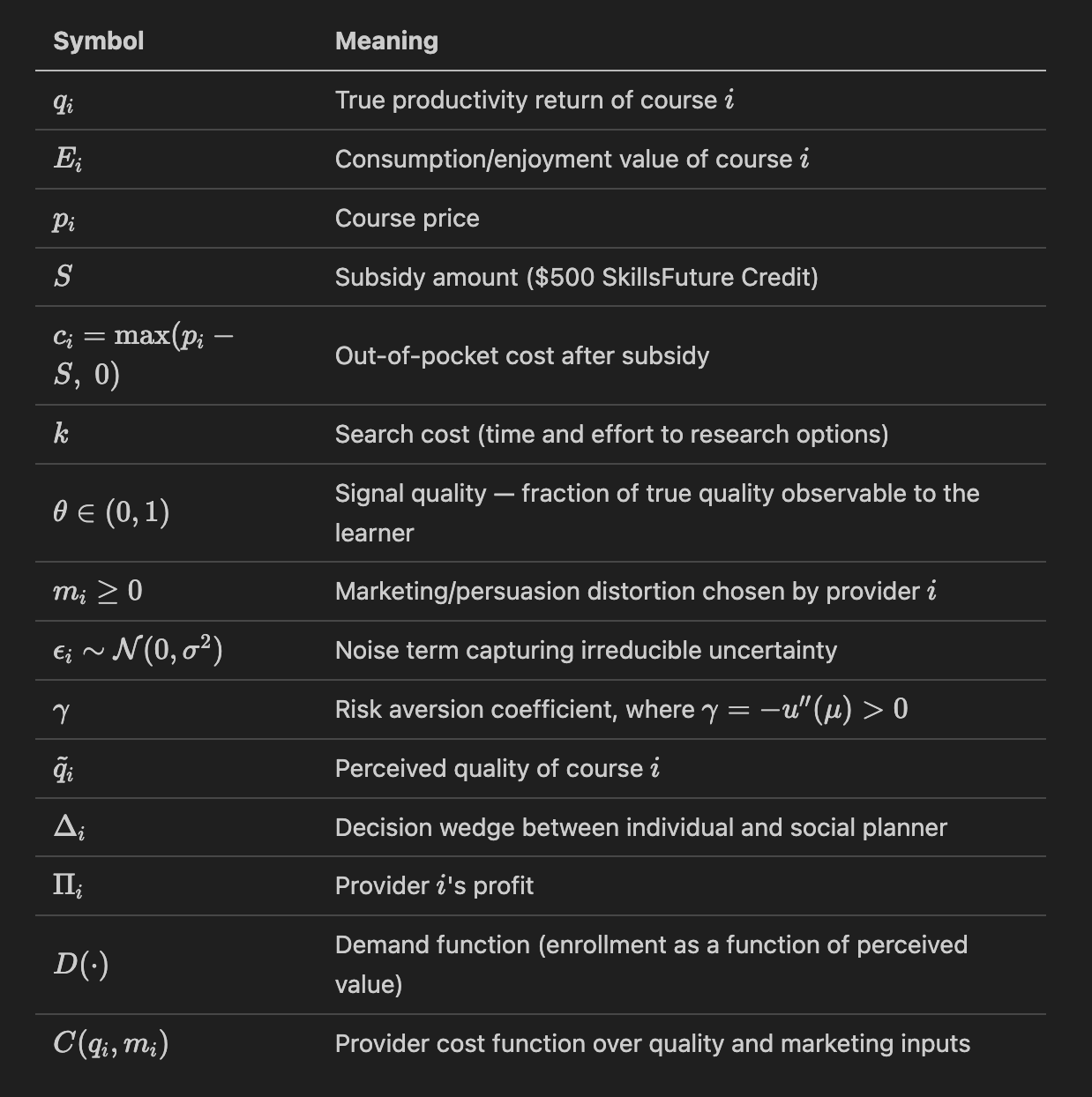
Variable Definitions
Key Equations
(1) Perceived quality signal
q̃_i = θq_i + m_i + ε_i
The learner observes a noisy, distorted version of true quality: discounted by signal quality θ, inflated by marketing m_i, and blurred by noise ε_i.
(2) Individual enrolment rule
θq_i + m_i + E_i ≥ c_i + k + ½γσ²
An individual enrols when perceived professional value plus enjoyment exceeds total cost (out-of-pocket plus search cost plus the risk penalty from uncertainty).
(3) Social planner’s rule
q_i ≥ c_i + k
The planner observes true quality and faces no uncertainty. Enrolment is efficient when productivity return exceeds cost.
(4) Decision wedge
Δ_i = (θ − 1)q_i + m_i + E_i − ½γσ²
The gap between the individual’s decision and the planner’s. Positive Δ_i means over-enrolment; negative Δ_i means under-enrolment. Note that (θ - 1) < 0, so the first term always pushes toward under-enrolment; m_i and E_i push toward over-enrolment; and the risk penalty pushes toward under-enrolment.
(5) Provider profit maximisation
Π_i = p_i · D(θq_i + m_i + E_i) − C(q_i, m_i)
Revenue depends on enrolment, which depends on perceived value. Cost depends on actual quality and marketing effort.
(6) Persuasion dominance condition
C′_m < C′_q / θ
A provider favours marketing over quality improvement whenever the marginal cost of persuasion is less than the marginal cost of quality divided by signal quality. Since θ < 1, the right-hand side is inflated — persuasion dominates even when it’s more expensive per dollar than quality, because quality improvements are only partially observed.
The Mean-Variance Derivation
The risk penalty isn’t pulled from thin air, it falls out naturally from the standard economics of decision-making under uncertainty.
Intuition. Someone offers you a guaranteed $100 versus a coin flip between $0 and $200. Same expected value. Most people take the guarantee. A risk-averse person behaves as if uncertain outcomes are worth less than their expected value — and the gap grows with how risky the bet is.
Formally. Consider utility over a random payoff X with mean μ = E(X) and variance σ^2. Take a second-order Taylor expansion of u(X) around μ:
u(X) ≈ u(μ) + u′(μ)(X − μ) + ½u″(μ)(X − μ)²
Take expectations. The middle term vanishes because E[X - μ] = 0. The last term picks up E[(X - μ)^2] = σ^2:
E[u(X)] ≈ u(μ) + ½u″(μ)σ²
For a risk-averse agent, u’‘ < 0. Define γ = -u’’(μ) > 0:
E[u(X)] ≈ u(μ) − ½γσ²
The agent acts as if they receive the expected payoff μ minus a penalty. This penalty is increasing in both risk aversion (γ) and outcome uncertainty (σ^2). Greater uncertainty about course quality mechanically depresses the individual’s willingness to enroll — even when the expected return is positive.